
Stirring the Cauldron
The Cancer New Moon and cosmic Cauldrons

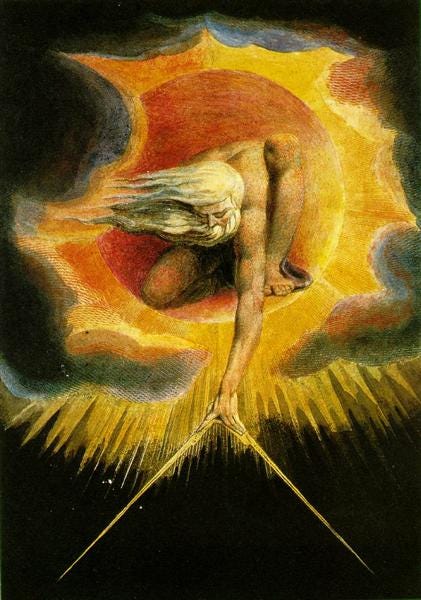
“The future, in imagination, is already among us.”
Ursula K. Le Guin
On the 14th July at 10:43am BST, the Sun and Moon meet at 21°59’ Cancer, joined by a retrograde Mercury.
At first glance this might seem a relatively quiet New Moon. Cancer is not usually associated with spectacle. Its concerns are closer to home: family, belonging, memory, ancestry, roots, nourishment, and the invisible bonds that hold people and communities together through changing times.
Yet beneath these familiar Cancerian waters, something extraordinary continues to stir. There is ‘that’ pattern finally coming into form in the sky. Some have called it a basket, others a chalice, or perhaps most fittingly, a cauldron. For one fleeting moment it even resembles an envelope! A missive from the gods?
For now, let’s think of it as some sort vessel. Something designed not merely to hold, but to carry potential.
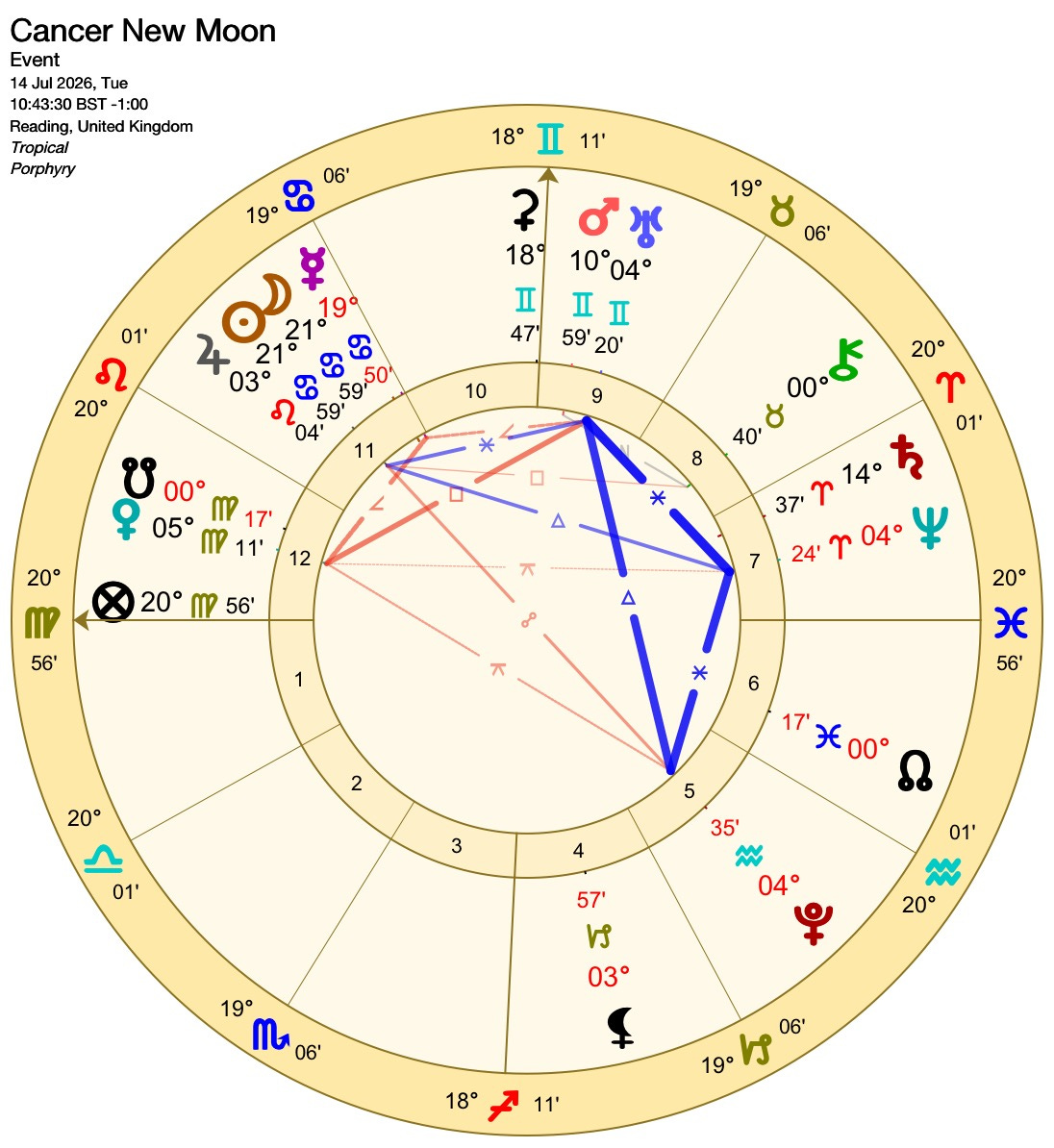
This New Moon feels to me like the nascent point of a larger story that is only just beginning to reveal itself. Not the culmination of a process, nor some dramatic celestial explosion that changes everything overnight, but a discernible shape emerging from the mists of possibility for the first time. Oh, it’s been around for a long time in the form of that ‘magic triangle’ between those behemoths of the outer solar system - Uranus, Neptune, Pluto - but nothing’s been quite clear and definable. It all seems shrouded in mist and confusion - which I suppose is unsurprising with Neptune so profoundly involved - and Pluto loves to hide in the deep shadows like a secret agent with an aura (or a helmet if we adhere to the mythology) of invisibility. And we’ve yet to decide whose ‘side’ he is on (for what it’s worth, like Tolkien’s Ents, he’s on no-ones side).
But things are now becoming clearer on an epochal way - and I’m really not exaggerating. The days immediately following this lunation contain one of the most remarkable planetary configurations of our age.
“We must be willing to let go of the life we have planned, so as to accept the life that is waiting for us.” - Joseph Campbell
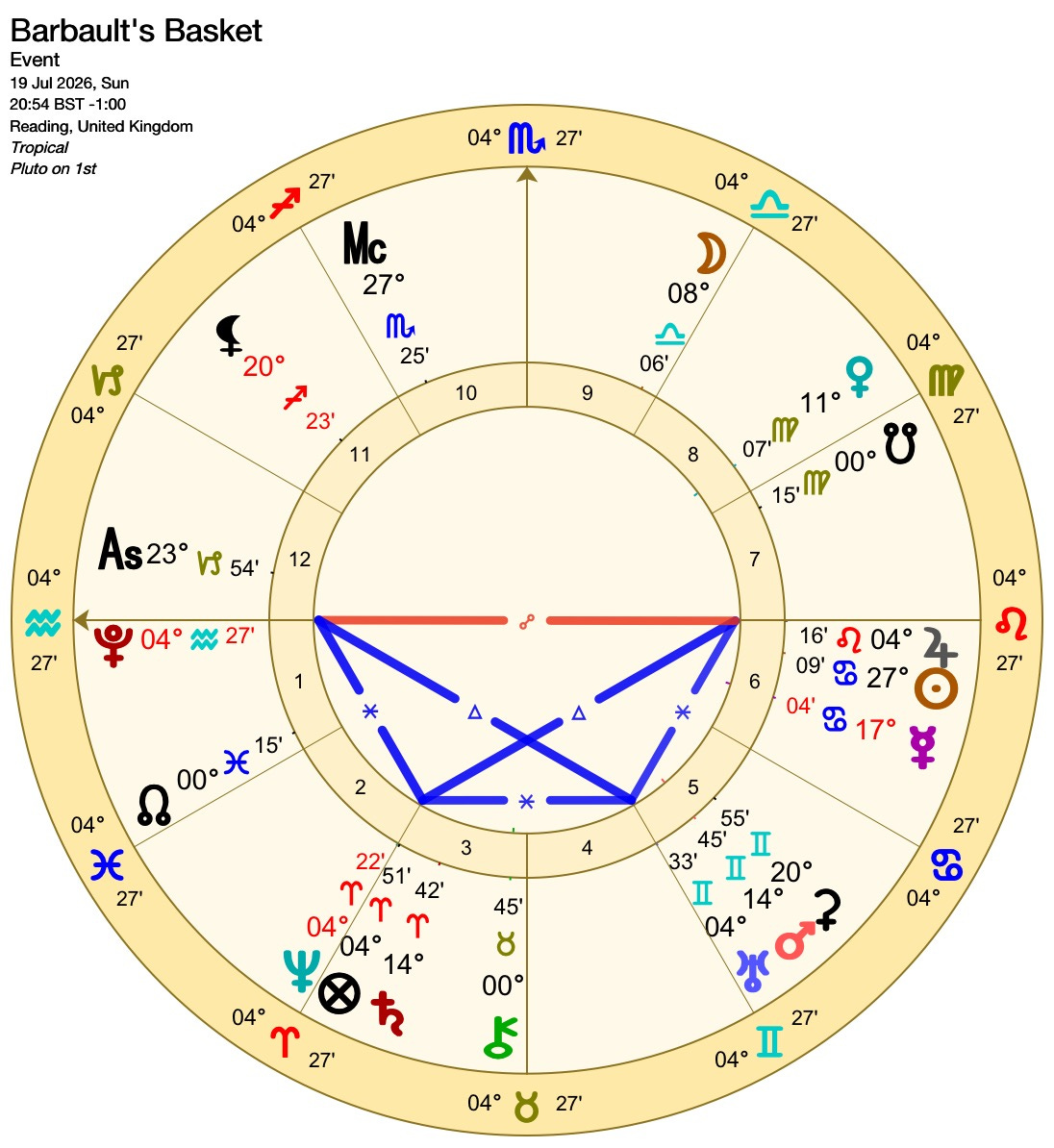
Between the 15th and 25th July, Uranus in Gemini perfects its sextile to retrograde Neptune in Aries before completing its trine to retrograde Pluto in Aquarius. Jupiter in Leo simultaneously trines Neptune, opposes Pluto, and sextiles Uranus, while Pluto and Neptune themselves remain in sextile. I’ve popped Pluto on the Ascendant for the chart above, to highlight the shape of this configuration - it could be cauldron, or a ship maybe, sailing on the cosmic stars of the Milky Way of destiny? I’ll leave you to decide.
Anyway, together these planets form the pattern that some astrologers have called Barbault’s Basket. I confess I prefer the other image I’ve talked about. If I hold this pattern in my mind within my spiritual practice this feels less like a basket and more like a sacred chalice - or a great cosmic cauldron.
Four immense powers gather around it, forming it’s rim and it’s legs: Jupiter, Uranus, Neptune, and Pluto, all occupying 4° of their respective signs. Some astrologers have suggested that configurations of this nature have not occurred for four, five, or perhaps even six thousand years. Whatever the precise figure, it is clear that we are witnessing something exceptionally rare. Yet even this is not quite the whole story.
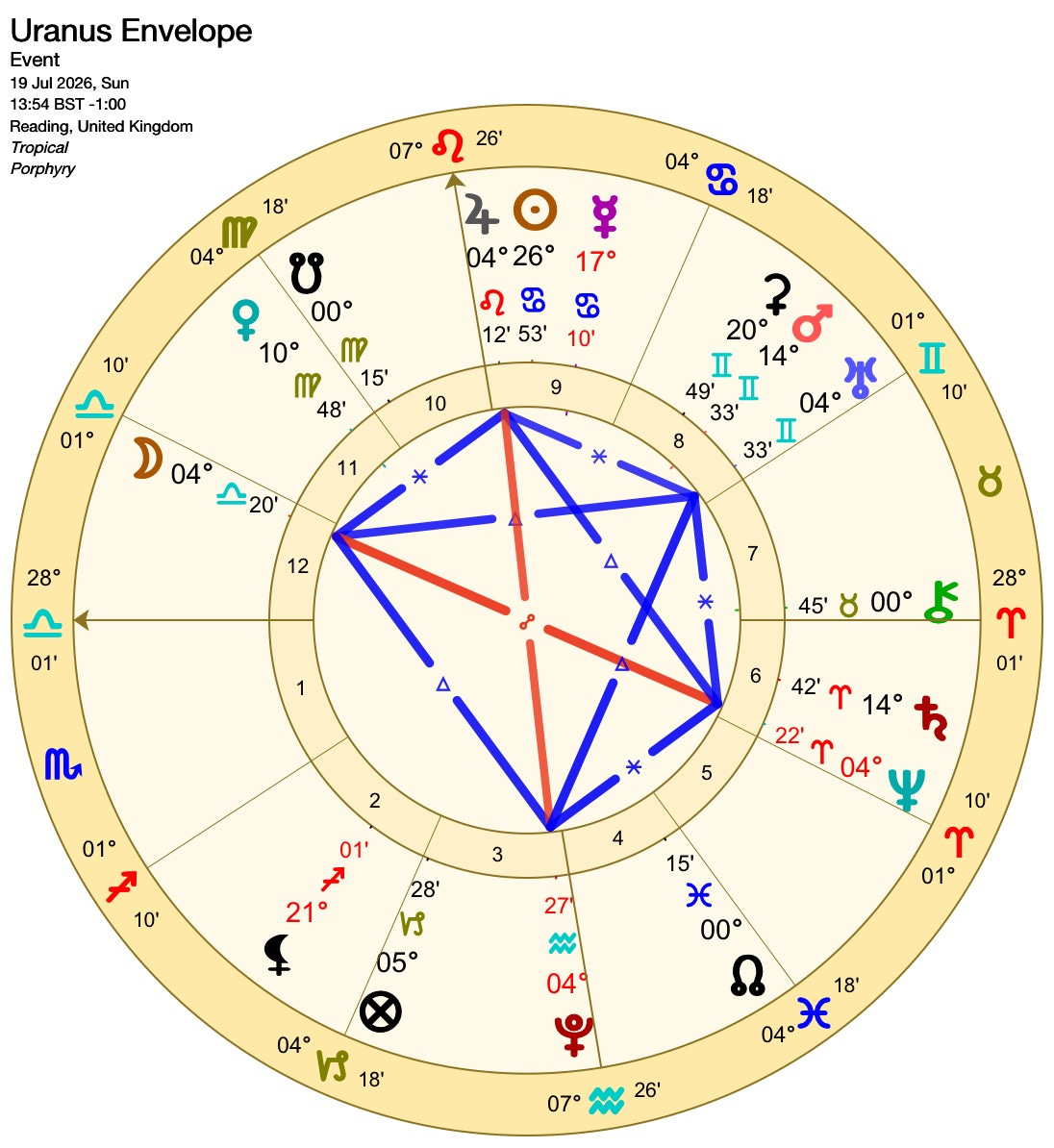
On the 19th July, the Moon enters Libra and briefly reaches 4°. For only a few hours it joins the pattern, transforming this cosmic Cauldron - or Basket if you prefer - into what some astrologers call an Envelope. For me, this is the moment the cauldron is given a final stirring - or woven together with the material world if that metaphor works better for you.
The outer planets describe vast collective forces moving across decades and generations. They operate on scales so large that they can be difficult to perceive directly. The Moon, however, belongs to human experience. She governs feeling, memory, instinct, relationship, and the tides of emotional life. When she joins the configuration, however briefly, the larger story touches the realm of lived experience. The future ceases to be merely theoretical, and instead becomes personal. And so the question becomes: what exactly is being stirred?
The temptation with astrology is always to look for singular events. We imagine a great cosmic thunderclap, a moment after which everything is suddenly different. But history rarely works that way. More often, the truly important moments are recognised only in hindsight.
We might look back to the financial crisis of 2008, to the Saturn-Pluto conjunction of 2020, or to the profound technological, political, and social transformations that have accelerated throughout the past decade. We can clearly see that much of what once appeared stable is no longer secure. Institutions struggle to command trust. Political systems increasingly polarise. Communities fragment. Old assumptions about identity, economics, communication, and power continue to unravel.
What is dying is often easier to identify than what is being born, and that uncertainty is reflected perfectly in the planets gathered around this celestial cauldron.
Neptune in Aries dreams new dreams while dissolving old certainties. It inspires vision, myth, spirituality, imagination, and idealism, yet can equally manifest as confusion, illusion, fanaticism, or wishful thinking.
Uranus in Gemini disrupts established ways of thinking. It accelerates innovation, communication, technology, and intellectual revolution. The rapid emergence of artificial intelligence offers perhaps the clearest expression of Uranian energy in our current era. Entire assumptions about creativity, our work and jobs, education, and even consciousness itself are being challenged.
Pluto in Aquarius works at an even deeper level. As lord of the underworld, Pluto concerns himself with power: who possesses it, who is excluded from it, and how it is exercised. In Aquarius he transforms collective systems, social structures, networks, and communities. Yet power is never merely political or economic. It is also mythological. The stories societies tell about themselves eventually become the foundations upon which laws, institutions, and identities are built.
Jupiter in Leo expands everything he touches. He brings vision, meaning, creativity, confidence, leadership, and the desire to participate in something larger than ourselves. Yet Jupiter also amplifies excess, certainty, and ideological conviction.
It is Jupiter’s opposition to Pluto that perhaps forms the heart of this pattern as the lip of the cauldron. Mythically, we might imagine Zeus facing Hades across the heavens. The ruler of Olympus stands opposite the ruler of the underworld. Meaning confronts power. Vision confronts control. Creativity confronts authority.
Neither can eliminate the other. Instead, they generate a living tension through which something new may emerge. Whether that emergence becomes liberating or oppressive remains unresolved.
And that is perhaps the most important point. Astrology does not tell us what must happen. It reveals fields of possibility.
We are already seeing many expressions of these planetary forces. Across much of the world there is increasing social fragmentation, economic uncertainty, ideological conflict, and growing concentrations of power. Fear becomes a political tool. Vulnerable groups become convenient scapegoats. People retreat into opposing camps and speak increasingly different languages of reality. Yet this is only one possible manifestation of the pattern.
The same astrology also speaks of innovation, creativity, community-building, new forms of cooperation, technological breakthroughs, spiritual renewal, and entirely new ways of imagining what human society might become.
The cauldron contains both possibilities; the ingredients are present. Still, as the Sun soon enters Leo, the fire will be lit. But the outcome as yet remains unwritten.
For me, this is where the Cancer New Moon becomes so deeply significant and important. While the larger planetary pattern speaks of collective futures, Cancer asks a profoundly intimate question: What are we willing to nurture?
Before societies change, people change; before institutions transform, values transform; before futures emerge, someone must first imagine them.
Cancer reminds us that every great movement begins somewhere small: around a family table, within a circle of friends, through acts of care, through communities choosing to support one another, through the stories we tell our children and the values we choose to embody.
As with all New Moons this is a beginning, not the culmination. It’s a moment, a seed, a first stirring within the cauldron.
Where are we now?
Where are we now?
The moment you know
You know, you know
“Where are we now” by David Bowie
And so, on the 19th, the Moon briefly joins that greater ‘Cauldron’ configuration to form that envelope, and asks whether we are prepared to participate in what comes next.
Opportunity is rarely announced by trumpets, more often it arrives quietly. But it always asks for attention, for courage, and most of all, it asks for participation. Blink and the moment, the opportunity may be gone, perhaps for good. If we ignore the possibilities emerging around us, others will shape them in our place.
But we are still not done with this momentous cycle. The final days of July continue to accelerate the story.
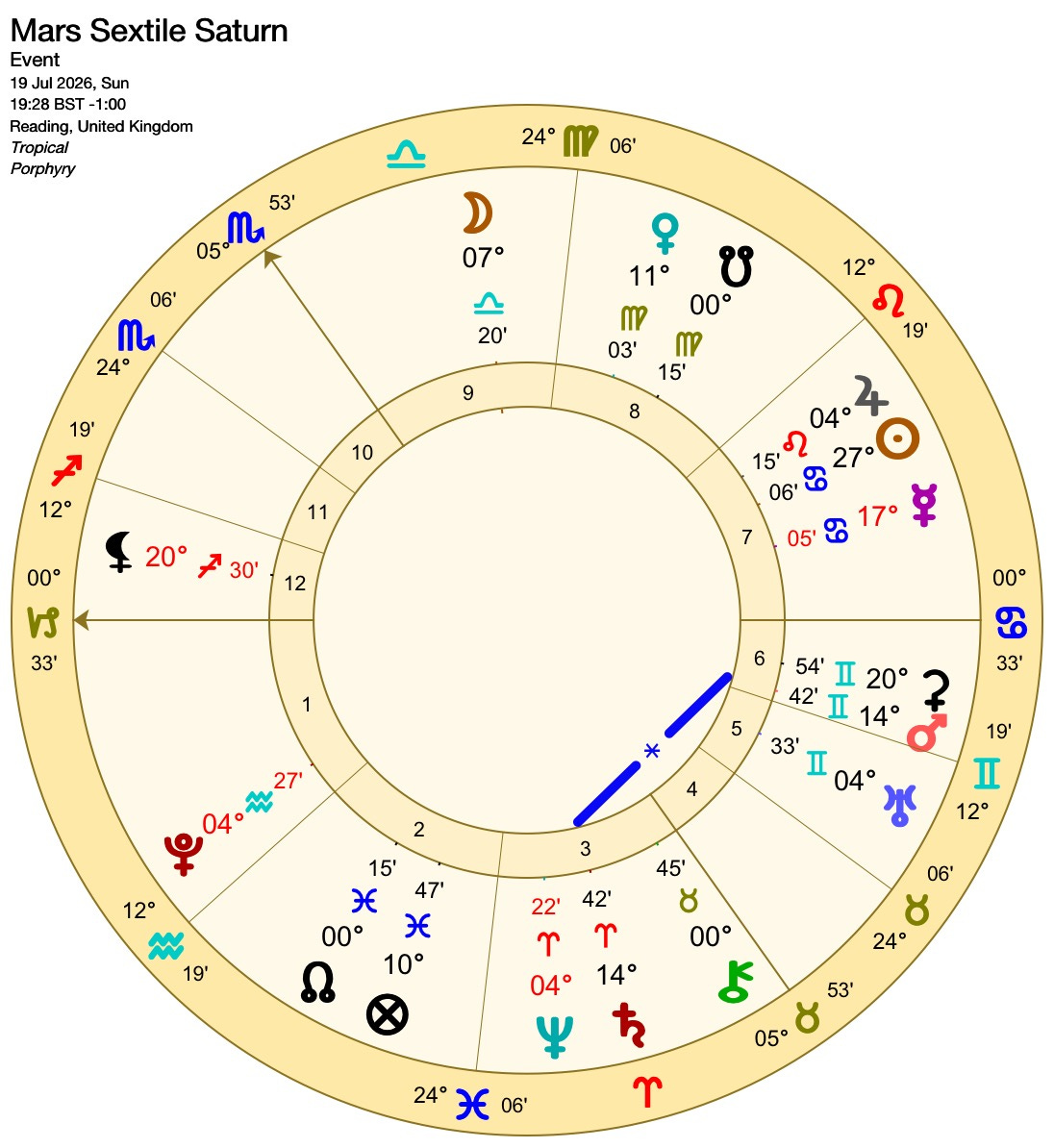
Mars in Gemini forms a productive sextile to Saturn in Aries, helping ideas find practical expression, while Venus in Virgo harmonises with Mercury in Cancer, encouraging thoughtful reflection and careful discernment. As Mercury turns direct on the 23rd, clarity begins to return, gently lifting the fog of recent weeks and allowing intentions to take clearer shape.
Amid this gradual shift, the Sun enters Leo on the 22nd. The fire really is now lit; the flames beneath the cauldron begin to rise.
“Hope does not mean saying this is not bad,
and it does not mean saying that we can defeat it.
It just means saying we will keep showing up.
That we will not give up...
we do not know how it will unfold, and neither do those we oppose.”
Rebecca Solnit
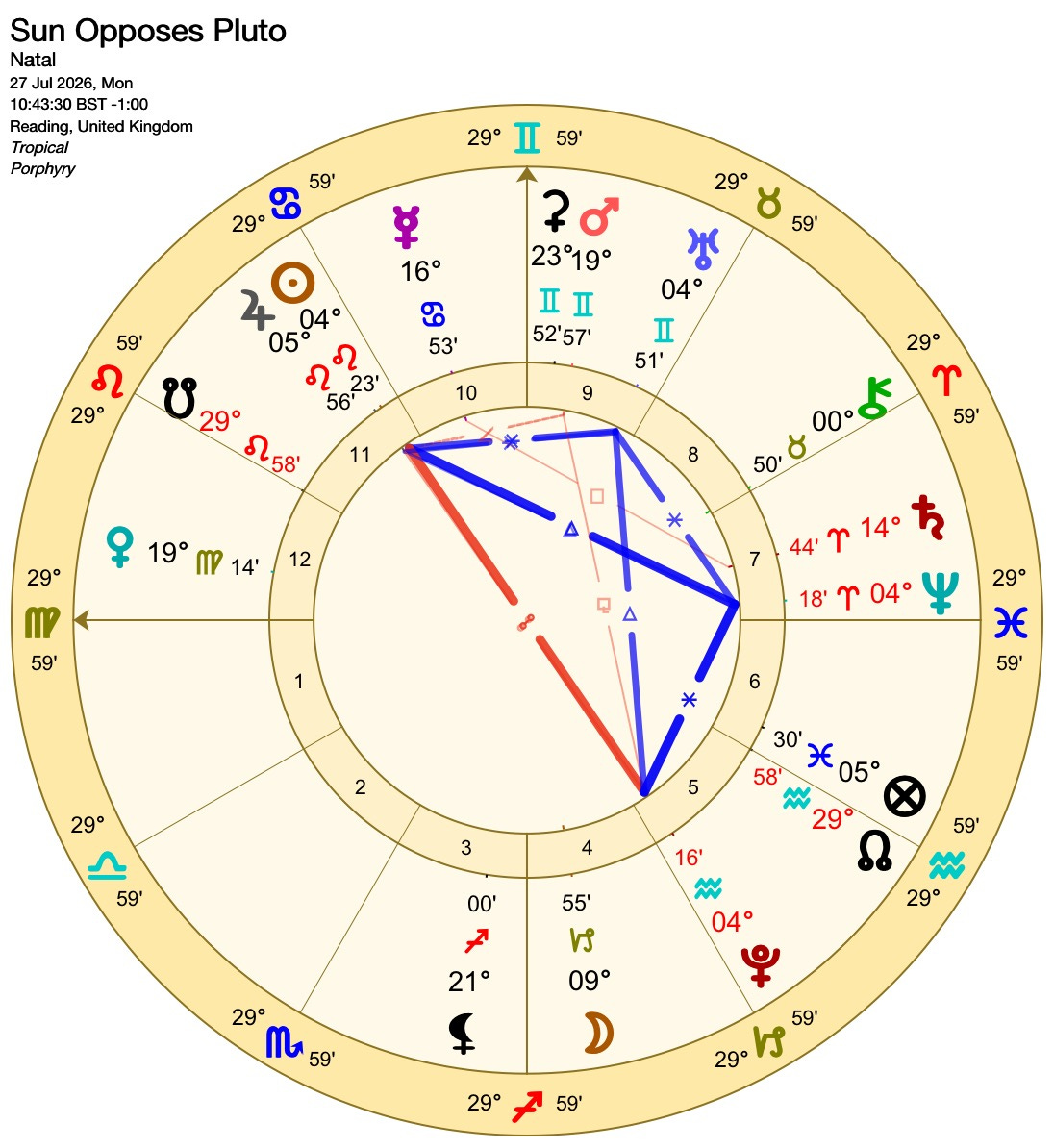
By the 27th, the Sun joins the wider planetary pattern, making a partile (exact) opposition to Pluto while forming the same harmonious aspects to Uranus and Neptune that we saw with Jupiter - a solar repetition of Jupiterian hopes, or the endless story of Earth and Sky? More echoes of ancient stories of Uranus and Gaia in the age of the Titans?
Two days later, the Sun conjoins Jupiter in Leo as Venus squares Mars and the Aquarius Full Moon approaches, intensifying the atmosphere and drawing the unfolding energies toward a point of culmination.
The cauldron begins to boil. And here, at its very rim, the tension between Jupiter and Pluto becomes unmistakable.
Jupiter in Leo, radiant and expansive, pours vision, meaning, creativity, and the desire to express something larger than the self. Pluto in Aquarius, deep and uncompromising, holds the forces of power, transformation, and collective destiny. Opposed across the heavens, they form the lip of the vessel itself - the edge where pressure gathers, where heat concentrates, where something must eventually spill over.
This is no quiet boundary. In the old traditions, there are words for what emerges at such moments. The Welsh speak of Awen - the flowing inspiration that cannot be forced, only received. The Irish speak of Imbas - the sudden illumination that rises from deep within, as if drawn up from hidden wells of knowing.
To me, this opposition feels like that. There is immense tension here, yes, but that tension creates a pressure building toward revelation. It’s the necessary friction that allows something new to rise to the surface. And here I’m minded of Merlin revealing the Red Dragon fighting with the White Dragon.
As the cauldron heats and the ingredients combine and transform, it is here - at the rim between Jupiter and Pluto - that inspiration gathers, swells, and inevitably overflows.
The question is not whether something will emerge, but what form that emergence will take. Yet even as the intensity builds, it is worth remembering where this all began, with a quiet New Moon in Cancer; with a vessel held close to the heart; with a question about what we are willing to nurture, protect, and bring into being.
For all the grandeur of the outer planets, all the mythic tensions and sweeping possibilities, the cauldron does not stir itself. It responds to what is placed within it. It responds to attention, to intention, to care.
Participation is not a grand gesture. It is not reserved for moments of spectacle. It begins in the smallest acts: in how we listen, how we speak, how we show up for one another, how we choose to imagine the future, and whether we dare to believe that our presence matters within it.
The Cancer New Moon reminds us that every great transformation has its origin in something tender, something human, something quietly chosen.
The fire is rising. The ingredients are gathering. The cauldron is alive with possibility, and at its rim, inspiration waits to spill. What remains is the question it has been asking all along: what will you bring to it?
Wondrous.